
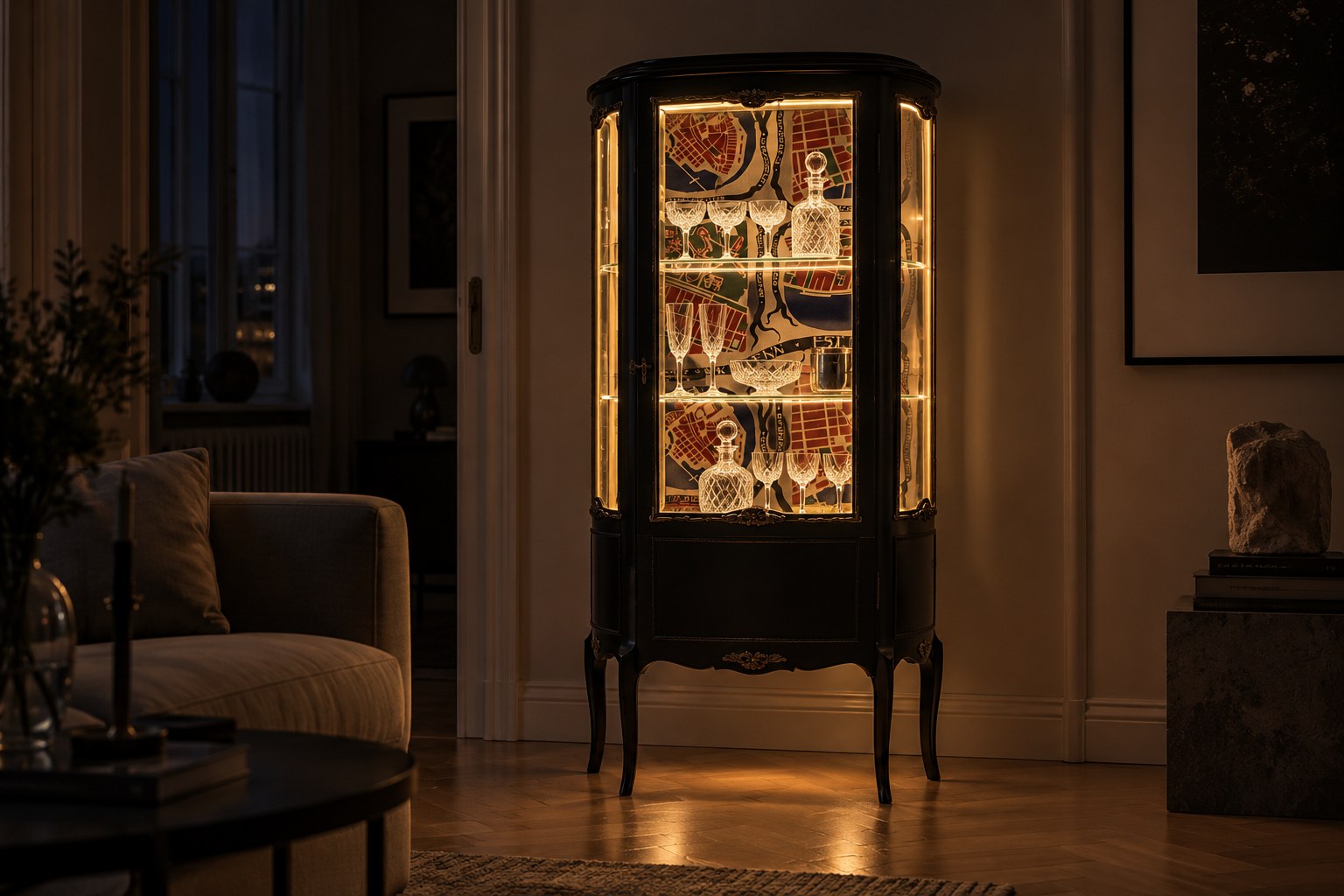
Display Cabinet with Lighting: LEDs, Spotlights, Glass Shelves and Good Light

Light is what distinguishes a display cabinet from a shelf in the evening. An unlit display cabinet is a dark block of glass in the evening, reflecting the room. A lit one is the warmest point in the room and the first thing you see on entering. Yet most of what is sold as a display cabinet with lighting gets it wrong: cool white LEDs that turn porcelain blue, spotlights with dazzling points of light, light that falls on the glass instead of the objects. This article explains how a display cabinet should be lit, what works in an old cabinet and what it costs. It is part of our large guide to the display cabinet.
LED strip or spotlight
An LED strip is a thin strip of diodes laid along an edge, usually under the top of the cabinet or on the front uprights. It gives even light across the whole cabinet and is what we recommend almost every time: it is invisible, does not get warm and lights every shelf equally. A spotlight is a point light in the top of the cabinet that shines straight down. It highlights whatever is on the top shelf and casts shadows on everything below. It works in cabinets with only one shelf or a single object, and in bar furniture, see Drinks cabinet or display cabinet. The combination, a strip at the sides and a dimmed spotlight above, is the luxury version for cabinets showing a few large objects. Anyone looking for a display cabinet with LED lighting gets the most discreet solution with the strip.
Warm white, not cool white
Colour temperature is stated in kelvin. 2,700 K is incandescent-warm, 3,000 K warm white, 4,000 K neutral, from 5,000 K cool white. A lit display cabinet should be 2,700 to 3,000 K. Cooler light turns white porcelain blue, brass grey and wood dead, and the cabinet looks like a refrigerated counter. The colour rendering, the CRI value, should be at least 90. Cheap strips have 70 to 80 and turn red into brown. Dimmable lighting is not a question of luxury but a must: a cabinet that glows too brightly in the evening is just as wrong as a dark one.
From above, from the side or from below
Light from above, from the top of the cabinet, is the classic and reaches the top shelf best. With glass shelves the light travels downwards but weakens with each shelf. Light from the side, strips along the front uprights, reaches all shelves evenly and is the best solution in tall cabinets with four or five shelves. Light from below, a strip in the base shining up through the glass shelves, is effective with crystal and glass but turns porcelain and books into silhouettes. In a cabinet with a black interior, see Black display cabinet, side light is enough. In a cabinet with a light interior, overhead light is needed so that the inside glows.
Glass shelves as light guides
Clear glass shelves with a ground edge carry the light from the top through the whole cabinet: the edge glows as a line, and every shelf receives light from below from the shelf above. That is why an old cabinet with wooden pegs and wooden frames for the shelves should be given new glass shelves before it is lit. Otherwise the light stays on the top shelf. The shelves should be 6 to 8 mm toughened glass, never frosted, and spaced 25 to 35 cm apart. Float glass with a green edge gives a green glowing line, low-iron glass a white one. Both are beautiful; they simply should not be mixed in the same cabinet.
Lighting in an old display cabinet
Retrofitting lighting in an old cabinet is simple if it is done properly. 12-volt LED strips are fixed with adhesive tape or in an aluminium profile along the top or the uprights, the transformer and cable disappear behind the back panel or in the plinth, and the cabinet has just one cable at the back. Wireless battery lighting, sold as a display cabinet LED strip, works in small cabinets but needs new batteries every few months and is seldom warm enough. A switch on the side of the cabinet or a dimmer in the cable is more convenient than a remote control that goes missing. As part of the restoration we add lighting to the cabinets where you wish it. Depending on size, allow roughly €150 to €350. You will find all current cabinets in the Display cabinets category, and what to check in an old cabinet before you put electricity into it is explained in Antique display cabinet.
Lighting and interior: how they work together
Light does nothing on its own; it illuminates the interior and the contents. Against a fabric in deep green or blue the light becomes saturated and warm, against a photographic motif it becomes a theatre window, against black lacquer a gallery. Against a worn veneer back panel it becomes a lamp in a storeroom. Lighting without a new interior is therefore only half the job. How to choose the interior is explained in the colour guide, and how to arrange the contents so that the light reaches them in Styling a display cabinet. An example of a piece with a designed interior is the black Louis XVI display cabinet with interior motif.
Frequently asked questions
Which lighting is best in a display cabinet?
A dimmable LED strip, 2,700 to 3,000 K, CRI 90 or higher, on the front uprights or under the top.
Do old display cabinets get hot from the lighting?
Not with LEDs. Halogen and incandescent bulbs, which were fitted in cabinets up to the 2000s, got hot and should be replaced.
Does a display cabinet with lighting need glass shelves?
Yes, if the cabinet has more than two shelves. Wooden shelves stop the light at the first shelf.