
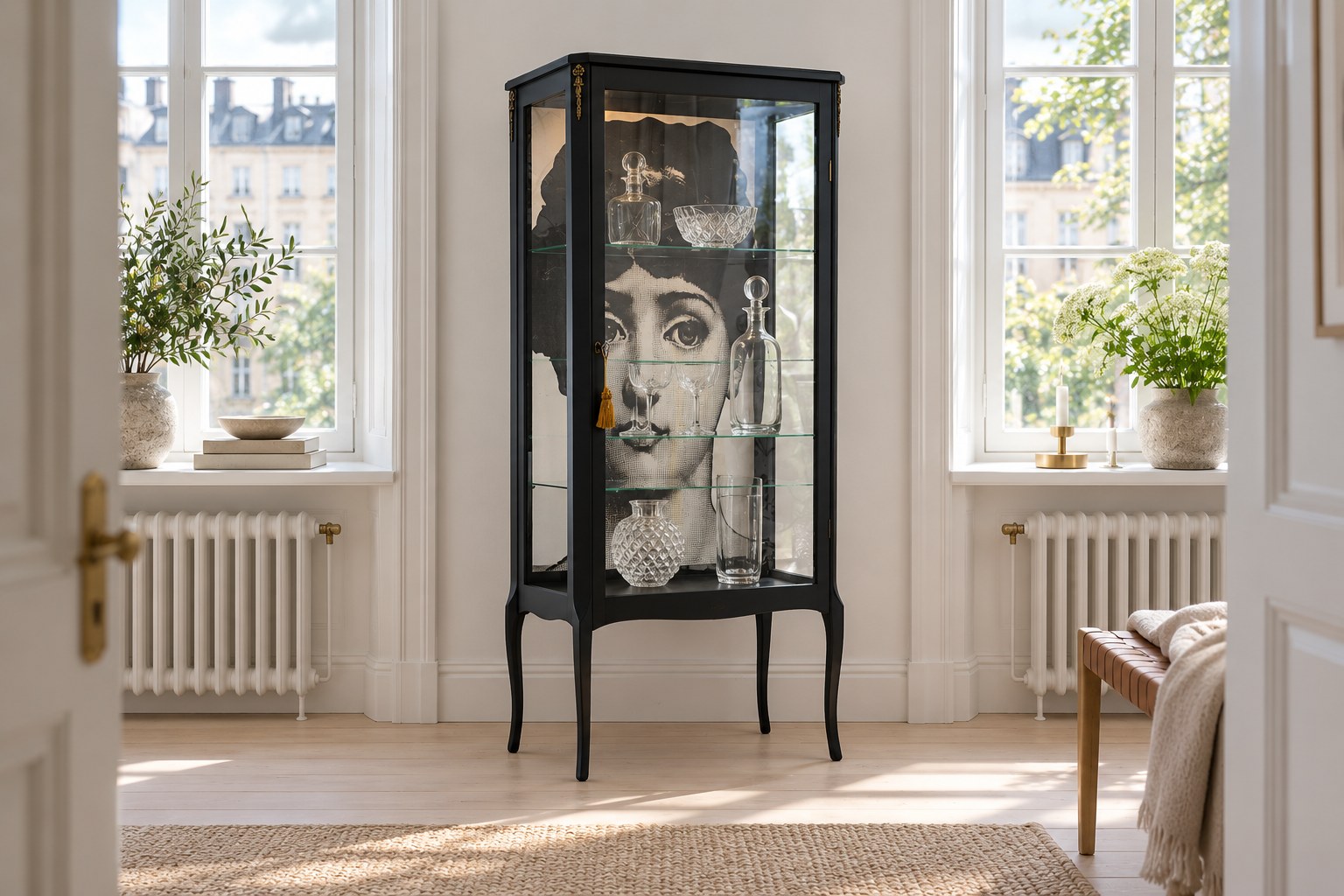
Narrow Display Cabinet: Dimensions, Placement and the Best Old Models



A narrow display cabinet is the answer to the most common problem in a period apartment: a wall too narrow for a cabinet and too wide to leave empty. The wall between two doors, the space beside the fireplace, the stretch between window and corner. A narrow display cabinet fills it without taking up much floor space, and still shows what you want to show. This article explains which dimensions count as narrow, how tall a narrow cabinet may be and which old models are the best. It is part of our large guide to the display cabinet.
What counts as narrow: 50, 60, 70 or 80 cm
A display cabinet under 60 cm wide is narrow. 60 to 70 cm is the most common width for old single-door display cabinets and fits most stretches of wall. 80 cm is the limit: wider is a cabinet of normal width. Depth matters as much as width: a display cabinet 30 cm deep fits in a hallway where 45 cm would block the passage. Old Swedish display cabinets are often 32 to 38 cm deep, which is why they work where new cabinets of 40 to 45 cm do not fit. Measure the wall, subtract 5 cm on each side and then measure the distance to the next piece of furniture so that the door can open 90 degrees. Anyone looking for a narrow white display cabinet will find a particularly large number of Gustavian-style models at this width.
Narrow and tall: the proportion that works
A narrow cabinet should be tall. A cabinet 60 cm wide and 120 cm tall looks like a box; the same width at 180 cm tall looks like a column and makes the room seem higher. The rule of thumb: the height should be at least two and a half times the width. The best old examples are the single-door Louis XVI display cabinets of the 1920s to 1940s: 60 to 65 cm wide, 170 to 185 cm tall, with glass on three sides and a single drawer below. One example of this type is the black Louis XVI display cabinet with brass details. Glass at the sides is decisive in a narrow cabinet: it lets the light through, and the cabinet does not look like a wall. A narrow cabinet with closed sides becomes heavy.
Placement: where narrow cabinets do the most
The hallway is the classic place: a narrow display cabinet 30 cm deep offers room for keys and gloves in the drawer and for something beautiful behind glass, without taking the passage. Between two windows, a tall narrow cabinet gives the room a focal point, and the glass does not reflect daylight because the windows are at the sides. Beside a tiled stove or fireplace, a narrow cabinet fills the niche that would otherwise become a corner for cables. In the bedroom, a narrow display cabinet works as a linen cabinet with glass, for coloured towels and perfume bottles. In the kitchen it is the china cabinet, see Styling a display cabinet. A narrow cabinet can also stand as a pair, one on each side of a door or a sofa, creating a symmetry that a wide cabinet cannot.
Narrow or small: the difference
A narrow display cabinet is tall and narrow, a small display cabinet low and short. They solve different problems: the narrow one takes a narrow wall, the small one a low wall or a spot on a chest of drawers. If you have a stretch under a window or a sloping ceiling, you are looking for a wall-hung or small display cabinet. If you have a wide but low wall, it is a low display cabinet. If you have full ceiling height but only 60 cm of width, it is this article.
Colour and wood in narrow cabinets
A narrow cabinet gains when it is dark: black or dark green emphasises the vertical line and turns the cabinet into a picture, see Black display cabinet. Light narrow cabinets in white or grey are the Gustavian tradition and suit rooms with light floors, see the colour guide. Narrow cabinets in visible wood, birch or mahogany, require the rest of the room to have the same wood, otherwise they are a piece of furniture on a visit, see Wooden display cabinet. Lighting achieves a great deal in a narrow cabinet, because the light from a single strip reaches the whole width, see Display cabinet with lighting.
What a narrow display cabinet costs
New narrow display cabinets from a furniture store cost €200 to €600 and are 40 cm deep, which is too deep for most narrow walls. Old single-door display cabinets cost €100 to €400 at auction, unrestored. Restored and redesigned by us, with new lacquer, a new interior and an adjusted door, they usually cost €1,200 to €1,600. You will find current cabinets in the Display cabinets category. If exactly the piece you want has been sold, a similar one can often be arranged by agreement; write to us via the contact page.
Frequently asked questions
How narrow can a display cabinet be?
Under 50 cm the shelves become too short for plates and books. 55 to 65 cm is the practical minimum.
Are there display cabinets 30 cm deep?
Yes, many Swedish display cabinets of the 1920s to 1940s are 32 to 36 cm deep. New ones are rarely under 40 cm.
Does a narrow display cabinet fit in the hallway?
Yes, it is one of the best places, provided the depth is under 35 cm and the door can open without blocking the passage.