
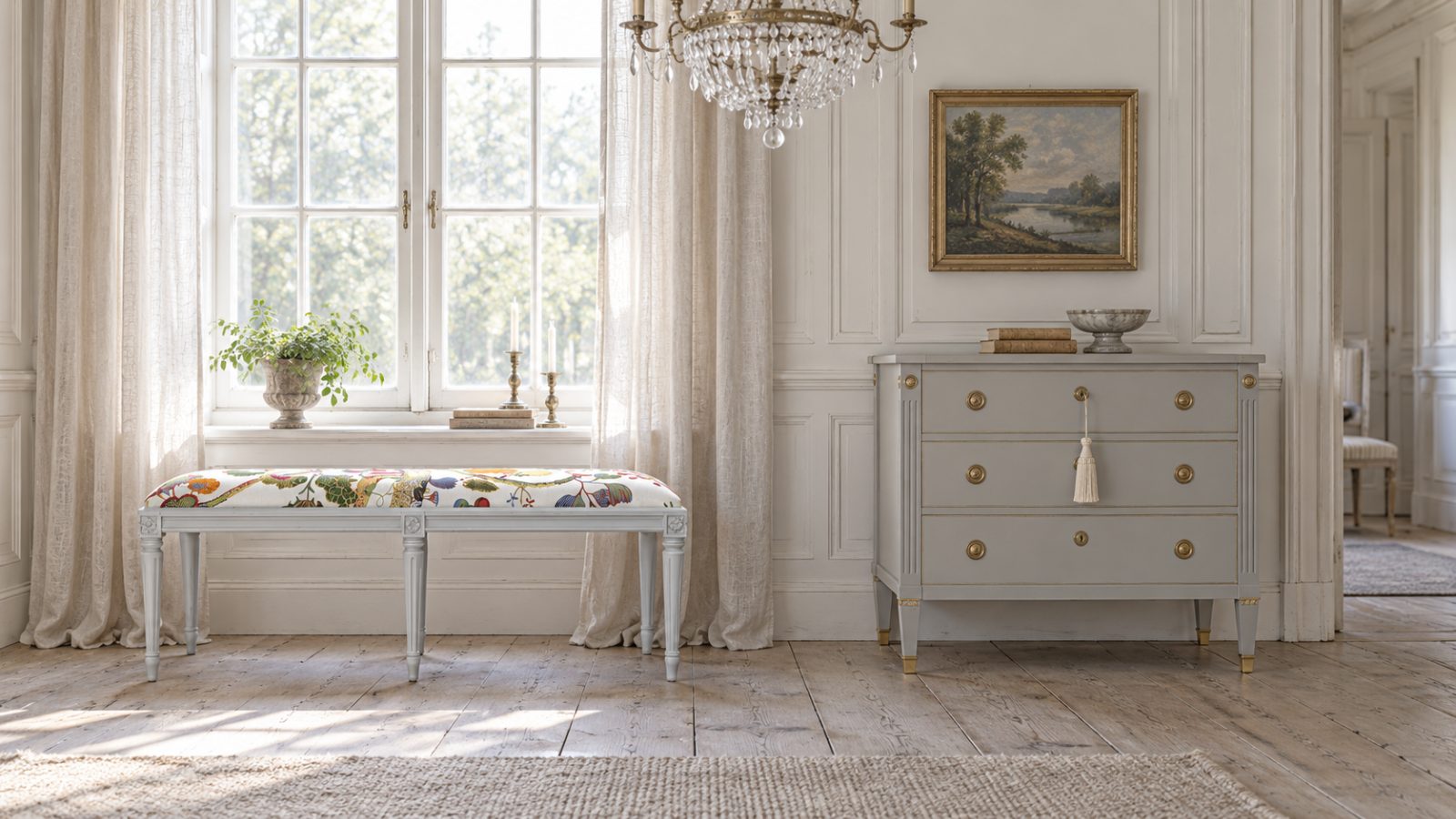
Scandinavian Country Style: Furniture, Colours and the Gustavian Roots


Scandinavian country style is one of the most searched-for interior terms in Germany, and one of the most often misunderstood. It usually means light, calm living with painted furniture, linen and plenty of light. What hardly anyone knows is that the furniture that carries this style is almost always Gustavian, a Swedish design language from the eighteenth century that is still built in series today. In this article we show what defines Scandinavian country style, which furniture belongs to it, how to recognise originals and why a black-lacquered Gustavian piece looks more modern than any new country-style furniture. You will find the place of this style among the others in the guide Scandinavian vintage furniture.
What defines Scandinavian country style
- Painted furniture in pearl grey, off-white, pale blue or grey-green, often with a visible patina.
- Straight, fluted legs that taper downwards, symmetry in the fronts, small carved rosettes or beading.
- Pale woods beneath the paint: pine and birch, and on finer pieces unpainted mahogany.
- Textiles in linen and cotton, checked and striped covers, little pattern.
- Light as a design tool: pale walls, mirrors, crystal, hardly any curtains.
The style arose under Gustav III from 1771 as the Swedish translation of French Louis XVI, pared back and lightened. That is why the furniture is called Gustavian. The term country style is a German trade designation, referring to the rural manor house of the eighteenth century.
The furniture: chest of drawers, display cabinet, cupboard, chair
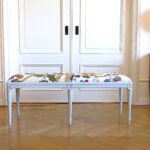
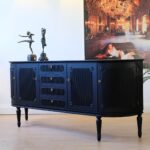
The country-style chest of drawers is the most sought-after piece: three drawers, a straight front, fluted corners, oval fittings. With us you will find it in the Chests of drawers and bedside tables category, and in the article Gustavian chests of drawers we describe how we work with them. The country-style display cabinet with glazing-bar doors and an interior mirror, like the green Gustavian display cabinet with a Josef Frank motif, with all the others under Display cabinets. Sideboards and cabinets, such as the Gustavian sideboard with brass fittings. Chairs and benches with a round or square back and an upholstered seat, like the grey Gustavian bench, with more under Armchairs and Chairs.
Original from the eighteenth century or period-style furniture?
Nine out of ten Gustavian pieces on the market were built between 1880 and 1960, when Swedish factories produced the style in series. That is no disadvantage: the period-style furniture of the twentieth century is often sturdier than the originals. You can recognise it by machine-sawn surfaces, even factory lacquering and frequently a stamp under the seat or behind a drawer. Genuine eighteenth-century pieces show hand-planed surfaces, wooden dowels instead of screws, many layers of paint with crazing and signs of use that fit the function. We work almost exclusively with period-style pieces, and that is precisely why we may repaint them.
Modern country style: the black variant
Pearl grey on white with linen is the classic interpretation, and it works. But it is also the predictable one. Our approach is to keep the Gustavian form and change the expression: matt black with brass fittings, a deep green, a hand-painted graphic pattern or gold leaf on the fluting. In a single dark colour, the rosettes and beading gain shadow and sharpness that disappear in grey. This turns a country piece into a design object that stands beside a modern sofa without saying a word. How such a solitary piece of furniture looks in a room is described in the article Furnishing with statement pieces.
Country style, shabby chic and Swedish Grace
Shabby chic is country style with deliberately rubbed-back paint, usually on new or imitation furniture. We like genuine patina on old pieces, but not artificial patina on new ones. Swedish Grace of the 1920s is the grandchild of the Gustavian style: the same classicism, but in veneer rather than paint, urban rather than rural. Anyone who understands country style also understands why Swedish Grace looks the way it does.
Frequently asked questions
Which colour is “Gustavian grey”?
Historically a pearl grey made from white lead and soot with a slight blue or green tinge. Today, shades around NCS S 2502-Y or S 3005-G20Y come closest to the original.
What does a chest of drawers in Scandinavian country style cost?
New MDF reproductions: €300 to €900. Unrestored Swedish period-style pieces: €200 to €800, plus work. Restored and redesigned by us: as a rule €900 to €2,400, including delivery within Germany.
May Gustavian furniture be repainted?
Period-style pieces of the twentieth century: yes, they are built for it. Genuine eighteenth-century pieces with their original paint: no, the patina is part of the value. We examine every piece before we do anything.